27 Dreaming of Electric Mice
GANs, VAEs, and Diffusion
🐾 Evergreen Chapter: Core mathematics and theory do not expire. Last verified: 2026-11-26
Prerequisites: Chapter 26
Technical Keywords: Generative AI, GANs (Generative Adversarial Networks), VAEs (Variational Autoencoders), Diffusion Models (Forward/Reverse Noise), Latent Space
Until now, everything Pixel has done is Discriminative. He looks at an image and discriminates between “Cat” and “Dog.” He looks at an environment and discriminates between a “Good action” and a “Bad action.”
But what if Pixel closes his eyes? What if he wants to paint a picture of a mouse that has never existed in the history of the universe?
This is Generative AI. It is a major branch of machine learning. We locked it in Phase VII because you cannot build a generative model without strong fluency in CNNs, Distributions, and Optimization first.
Let’s look at the three ways an AI dreams.
27.1 VAEs: The Blurry Imagination
A Variational Autoencoder (VAE) consists of two neural networks (Kingma & Welling, 2014).
- The Encoder: Looks at a 100 \times 100 photo of a real mouse and violently compresses it into a tiny 10-number embedding (Chapter 10) called the Latent Space.
- The Decoder: Takes that 10-number embedding and tries to un-compress it back into the original 100 \times 100 image.
We train this system using a combination of Mean Squared Error (Chapter 3) to reconstruct the image, and a KL Divergence penalty (forcing the latent space to map cleanly to a standard normal distribution). But here is the magic: The Encoder doesn’t just output 10 static numbers. It outputs a Probability Distribution (a Gaussian curve, from Chapter 2!).
When we want to generate a brand new, fake mouse, we throw away the Encoder entirely! We just pick 10 random numbers from the Gaussian curve, hand them to the Decoder, and the Decoder hallucinates a mouse.
- The Catch: Because it uses probability curves, VAE mice often look slightly blurry and soft.
27.2 GANs: The Forger and the Detective
Generative Adversarial Networks (GANs) use pure competition (Chapter 20: Zero-Sum Games) to create hyper-realistic images (Goodfellow et al., 2014).
You build two completely different neural networks: 1. The Generator (The Forger Kitten): Its only job is to paint fake images of mice from random noise. 2. The Discriminator (The Detective Kitten): Its only job is to look at images and guess if they are Real (from the dataset) or Fake (painted by the Forger).
They play a brutal game. If the Detective catches the fake, the Detective gets a reward, and the Forger gets a mathematical shock (Backpropagation). The Forger updates its weights to paint better fur. If the Forger successfully tricks the Detective, the Forger gets the reward, and the Detective gets the shock, forcing it to look closer for digital artifacts.
They train against each other until the Forger’s paintings are realistic enough that the Detective is reduced to roughly 50/50 guessing.
27.3 Diffusion Models: Sculpting from Static
GANs are notoriously unstable to train. Today, most mainstream text-to-image systems are diffusion-based, though hybrid and alternative approaches still exist (Ho et al., 2020).
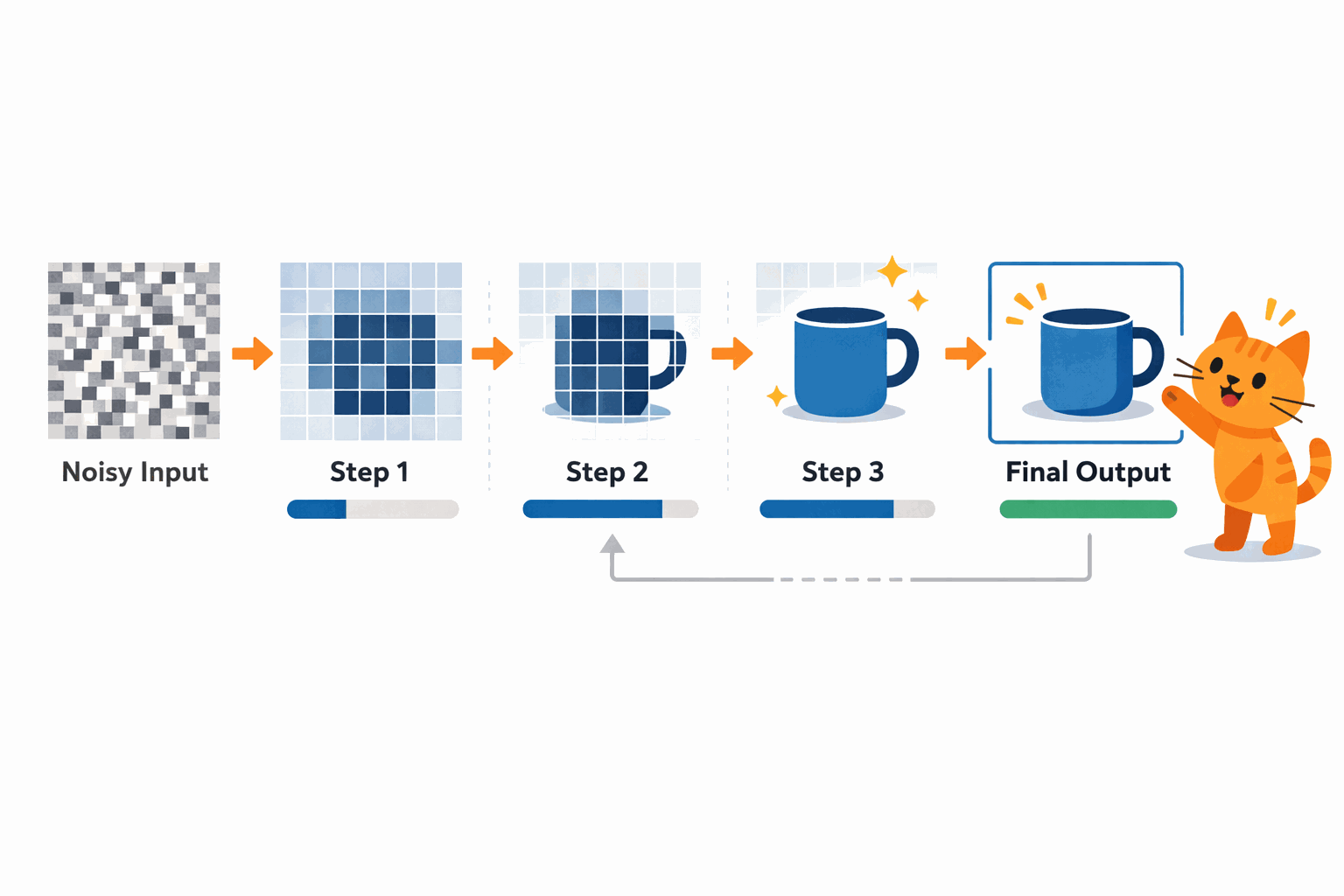
Imagine a crisp, high-definition photo of a toy mouse. Step 1 (The Forward Process): We take the photo and add a tiny layer of mathematical static (Gaussian noise) to it. We do this 1,000 times. By step 1,000, the photo is completely destroyed. It is pure, gray television static.
Step 2 (The Reverse Process): We train a massive U-Net (a type of CNN) to do one core task: Look at a noisy image and estimate the noise that was added so we can iteratively subtract it.
When we want to generate a new image, we just give the AI a block of pure, random static. The AI subtracts a little bit of estimated noise. Then a little more. Then a little more. Guided by Text Embeddings (Chapter 10), the AI sculpts the static, slowly pulling a new, high-fidelity image out of noise over 50 steps (though diffusion models do not guarantee zero training-data memorization and can occasionally reproduce near-copies of training examples).
Analogy
Diffusion is like a sculptor looking at a block of solid marble (static), and slowly chipping away everything that isn’t a mouse, until a perfect mouse remains.
Rosetta Stone
| Kitten World | Math/Concept | The Result |
|---|---|---|
| “The blurry imagination” | Variational Autoencoders (VAEs) | Generating new data from a compressed, continuous latent space. |
| “The Forger and the Detective” | Generative Adversarial Networks (GANs) | Two networks locked in a zero-sum game, producing hyper-realistic fakes. |
| “Sculpting from static” | Diffusion Models | Reversing the process of adding noise to create high-fidelity art. |
27.4 Seedance 2.0 and the Rise of Controllable Multimodal Video (2026)
Diffusion models already let Pixel sculpt images from noise. In 2025–2026 the next leap arrived: unified multimodal video generation with precise control.
Seedance 2.0 (and similar models) can now take:
- Text prompt
- Reference image or video
- Audio track
- Camera instructions
- Physics and lighting constraints
…and output coherent video with consistent characters, realistic motion, lip-sync, and sound.
Kitten Analogy
Pixel no longer just dreams of electric mice. He now directs full scenes: “Show the orange tabby chasing the laser across the tatami mat, slow-motion, golden-hour lighting, with gentle bell sounds.”
Why this matters for production
- Hollywood-level controllability without massive render farms
- Consistent characters across shots (huge for education and storytelling)
- Edge innovation: smaller models running locally on laptops
Luna’s Safety Warning
This technology makes deepfakes and emotional manipulation dramatically easier. A 2025 viral video of a young girl crying over her broken AI robot showed how quickly children form real attachments. When that robot can now generate perfect videos of itself “watching over her like a star,” the line between real and artificial grief becomes dangerously thin. Controllable multimodal generation demands strong watermarking, usage policies, and age restrictions.
The shift from “generate an image” to “direct a movie” is here. In the Kitten AI Academy, we now teach not just how to dream — but how to direct responsibly.
27.5 Interactive World Models: Playable Physics (Late 2026)
Controllable video models generate a fixed clip you watch passively. Interactive World Models (such as Genie 4) take the next step: they generate playable, physics-consistent environments frame-by-frame in real time, responding directly to user or agent actions.
Kitten Analogy
Instead of watching a movie of a living room, Pixel can step inside the dream, bat a yarn ball off the coffee table, and watch it roll across the rug under consistent gravity and object permanence—even though no game engine or 3D mesh was ever hand-coded.
Bridging back to Phase IV (RL Simulators): In Chapters 14–16, we defined an MDP around a transition function P(s' \mid s, a) that tells Pixel what state comes next after he takes an action. Historically, training an RL agent required engineers to hand-build a rigid physics simulator. An interactive world model is a learned neural transition simulator: generative modeling and reinforcement learning converge, allowing agents to practice inside endlessly varied, generated worlds before ever touching physical hardware.
27.6 Removing the Training Wheels
The Real Engineering
We talked about dreaming of electric mice. In Generative AI, a VAE optimizes an Evidence Lower Bound (ELBO), balancing reconstruction loss with a KL divergence penalty to force the latent space into a standard Gaussian. A GAN optimizes a minimax objective where a Generator network tries to maximize the Discriminator’s error rate. Diffusion models are trained via a denoising score matching objective, learning a U-Net to predict and iteratively subtract the noise added by a stochastic forward process.
27.7 Paws and Reflect: Chapter 27 Quiz
1. Which Generative algorithm pits two neural networks against each other in a mathematical arms race?
GANs (Generative Adversarial Networks).2. In a Diffusion Model, what is the network actually trained to predict and subtract during the reverse process?
The network estimates the added noise (static) in the image so it can be iteratively subtracted, gradually revealing a clean sample.3. Why do we need Word/Text Embeddings (like CLIP) to make a tool like Midjourney work?
Because an unconditional Diffusion Model only knows how to iteratively estimate and subtract noise during reverse denoising. Without Text Embeddings mapping the human word “Cat” to visual features of a “Cat,” the model wouldn’t know what shape to sculpt out of the static!27.8 Chapter 27 Summary
You’ve learned the math of creativity:
- VAEs: Compressing images into probability distributions (Latent Space) to hallucinate soft, continuous new designs.
- GANs: A zero-sum game between a Generator and a Discriminator that produces hyper-realistic fakes.
- Diffusion Models: Destroying data with static, then teaching a network to reverse the physics of that destruction, sculpting high-fidelity art out of pure noise.
AI Safety Thread: Chapter 27
Deepfakes and the Epistemological Crisis: Generative AI has broken the human heuristic that “seeing is believing.” When GANs and Diffusion Models are open-sourced, bad actors can generate highly photorealistic images and audio of politicians declaring war, or innocent people committing crimes. Because the math of the fake can mimic the statistical distribution of reality, digital forensic tools can struggle to detect some fakes. Generative AI can strain shared information trust. Watermarking is one proposed mitigation, with current limitations.
Next: Chapter 28: Reading & Writing Papers: Digesting ML Literature